Specialty service · wine column & dual-zone cabinet
Sub-Zero Wine Column Temperature Drift in Novato — Diagnosed, Not Guessed
4.9 network rating264 verified Sub-Zero repairs across our Bay Area service network
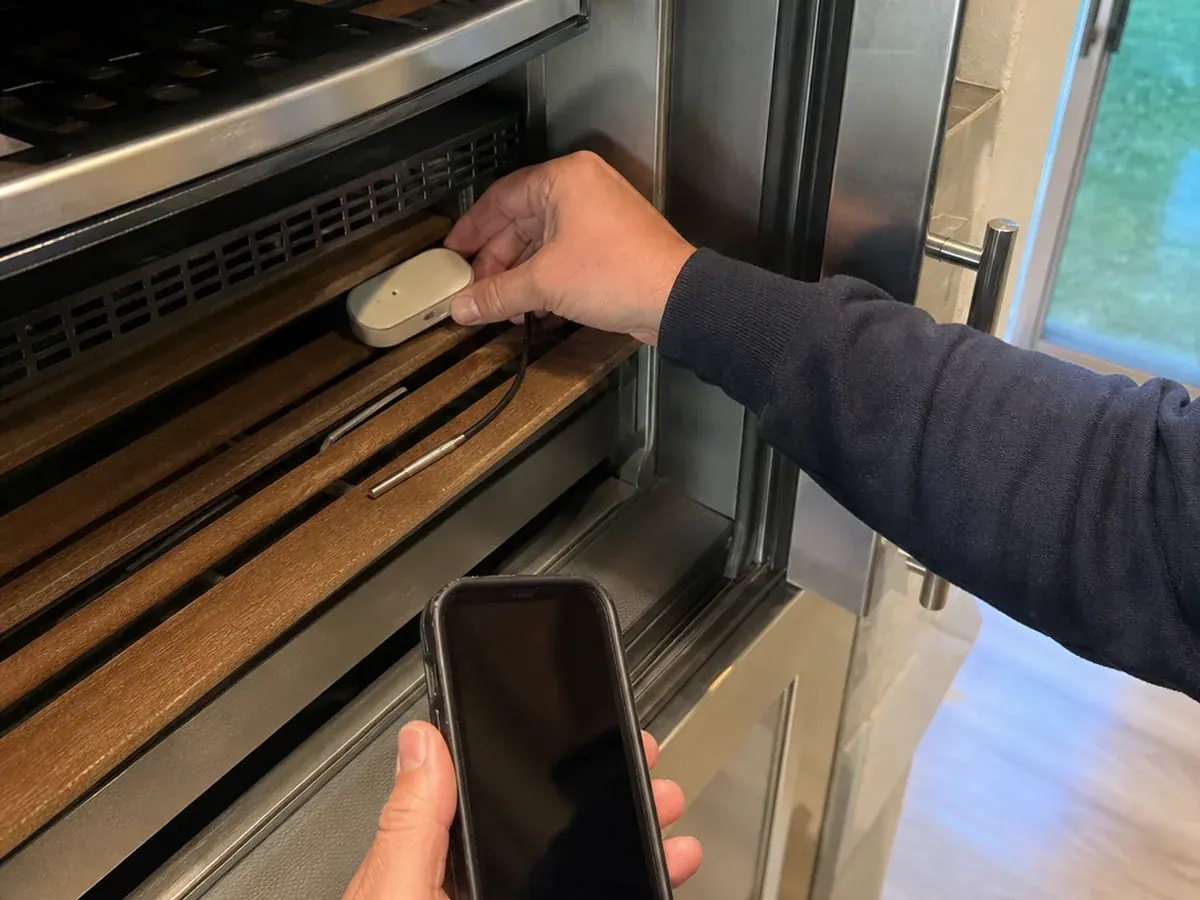
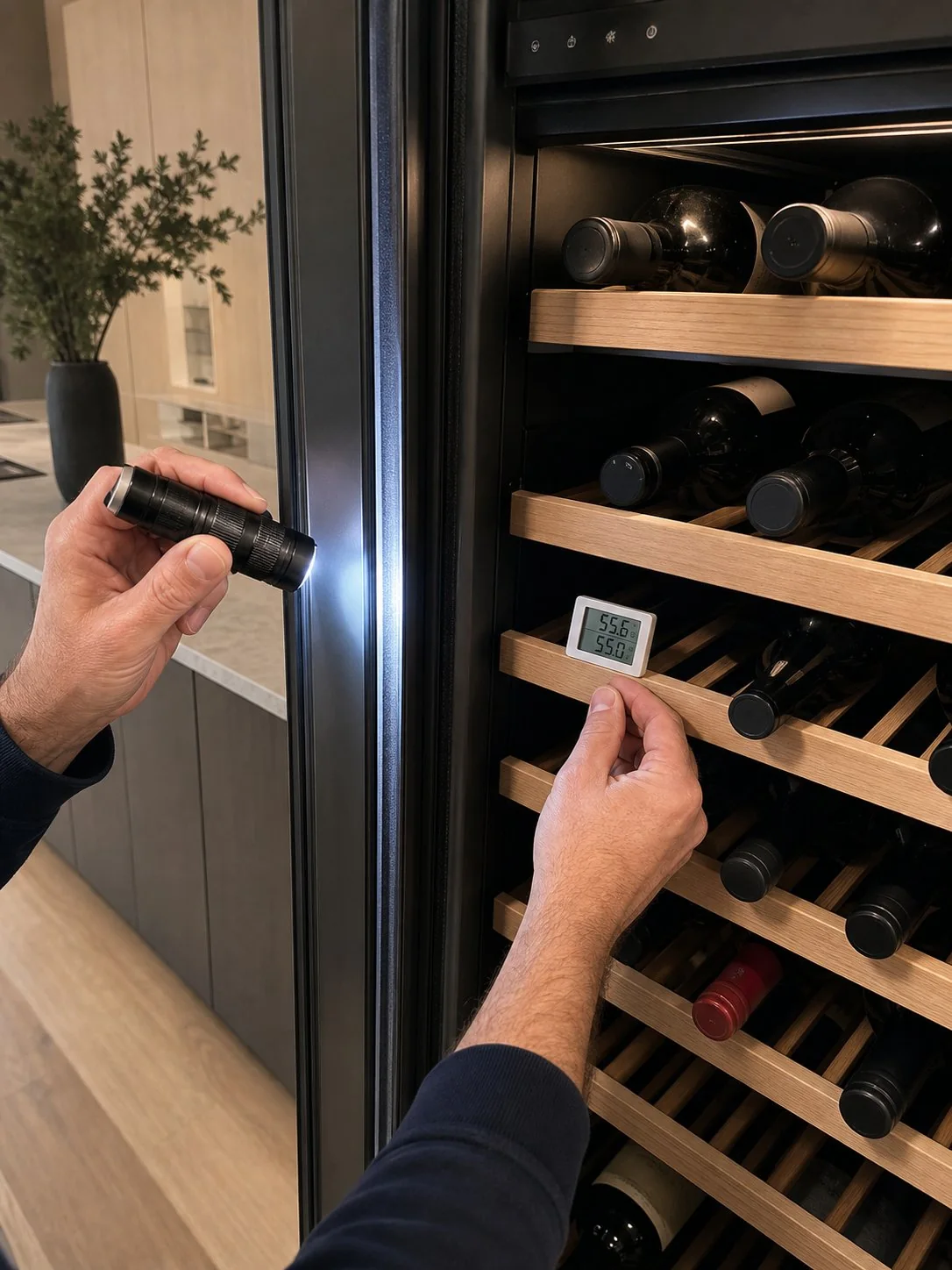
Temperature logging at bottle level. A data logger in the wine zone confirms real shelf temperature instead of relying only on the front display.
Direct answer
A Sub-Zero wine column drifting above setpoint in Novato is most often a thermistor that reads low, a hardened door gasket, or a weak evaporator fan — confirmed by logging actual zone temperature, not the front display. In homes around Pacheco Valle, where integrated wine columns sit in tight cabinetry, we also see restricted airflow compounding a borderline fan. And when the nearby ice maker starts producing hollow cubes or running slow — a related cold-side symptom that shares the same diagnostic logic — it tells us the cold side has broader load problems, not a single isolated fault. Call (415) 683-1487 with your model number and we'll advise what parts to have on hand for a one-trip fix.
The second paragraph unpacks what "drifting several degrees" actually means on a Sub-Zero wine column. The front-panel display reads the nearest thermistor to the control board — not the midpoint of the wine zone. So a cabinet showing 55 °F can have bottles sitting at 59 °F or 61 °F, silently. What diagnosis confirms is the gap: we place a datalogger at bottle level, run it overnight if needed, and compare that trace to the board's reported reading. What cannot be known before inspection is whether the drift is constant or cyclic — a cyclic pattern points to a different cause than a steady one, and that distinction changes which parts we bring.
Bottle-level logging. Wine columns are verified at the shelf, not only at the front display, because bottle temperature is what matters.
Why is my Sub-Zero wine column temperature drifting in Novato?
A Sub-Zero wine column that wanders off setpoint in Novato, including waterfront kitchens near Bel Marin Keys and ZIP 94949, usually points to a drifting thermistor, a hardened door seal, or a tired evaporator fan. We log bottle-level temperature first. Call (415) 683-1487 to book a technician.
Why a wine cabinet isn't a generic refrigerator repair
Sub-Zero built the wine column to hold a narrower temperature band than any food refrigerator — typically 45 °F to 65 °F, cycling within about two degrees. That precision demands more from the thermistor, the evaporator fan speed, and the door seal than a food unit running at 37 °F ever does. A standard refrigerator can absorb a small thermistor offset and still protect food; a wine column with the same offset can push a delicate red or white several degrees outside the target band for weeks without triggering any alarm.
In Novato homes — particularly the newer builds in Pointe Marin and the older coastal properties near Bel Marin Keys — Sub-Zero wine columns are frequently framed into cabinetry with minimal clearance. The marine fog cycles that move through this part of Marin County contribute to gasket rubber hardening faster than in drier inland climates, and corrosion on condenser fins can restrict airflow that the wine column's smaller thermal mass can't absorb. That's not generic refrigerator behavior, and it doesn't take a generic repair approach. We diagnose specifically against the wine column's engineering spec, not against a food-unit benchmark.
Age belongs in the wine-column conversation too. The oldest 424 and 427 cabinets in Novato are decades into service, and when a major fault lands on one of them the question shifts from parts to economics — the repair-or-replace breakdown for built-ins applies to wine columns just as it does to refrigerators, with panel and cabinetry costs doing most of the deciding.
Five most common findings
What we find on Sub-Zero wine columns running off setpoint
Thermistor drift
Symptom
Display reads correct setpoint; bottle-level temperature consistently 3–6 °F higher. No alarm triggered.
Diagnosis
Thermistor resistance reading compared against Sub-Zero's spec curve at ambient temperature; datalogger trace showing early compressor shutoff.
Parts
OEM thermistor for the specific wine column model. Clip-in or wired depending on generation.
What changes the quote
Age of the control board — a thermistor that has dragged a board into repeated short-cycles sometimes pulls the board out of spec at the same time, requiring both parts.
Door gasket compression failure
Symptom
Wine zone warm, humidity visible on the glass, occasional frost line at the door frame. Both zones affected or just one depending on which door is leaking.
Diagnosis
Visual inspection for flat-spotted gasket profile; dollar-bill pull test; compartment humidity vs. ambient. Also check hinge alignment, since a door pulling out of square causes gasket gaps even on an otherwise sound seal.
Parts
OEM gasket in the correct profile for the wine column model. Profile varies between single-zone and dual-zone units — not interchangeable.
What changes the quote
If the door hinge or frame is pulling the cabinet out of square, a gasket alone won't hold. That means a reseat and alignment step is added to labor.
Evaporator fan fault
Symptom
Upper zone warm while lower zone holds closer to setpoint, or temperature stratification visible on a logger — colder at the bottom, warmer at the top of the column.
Diagnosis
Fan motor amperage draw; blade spin test; evaporator frost pattern (uneven frost suggests inadequate air circulation rather than refrigerant deficit).
Parts
OEM evaporator fan motor matched to the wine column — voltage and blade pitch differ from food-refrigerator fans in the same product family.
What changes the quote
Restricted airflow from cabinetry installation can mimic a weak fan. We check clearance before replacing parts.
Control board / display alarm
Symptom
Panel flashing a temperature alarm or error code; zone refusing to hold setpoint after a power cycle; display reading erratic numbers unrelated to actual temperature.
Diagnosis
Board diagnostic output read via panel button sequence; thermistor and fan circuits tested independently to rule out sensor faults feeding bad data to a functioning board. A control board, thermistor or display alarm combination sometimes presents together.
Parts
OEM control board specific to the wine column generation. Some boards require a paired software handshake on first power-up.
What changes the quote
If the error is sensor-driven rather than board-driven, replacing the board without clearing the sensor fault accomplishes nothing. We confirm root cause before ordering.
Condenser restriction / airflow
Symptom
Wine zone gradually warming over weeks; compressor running continuously; condenser area warm to the touch well above the top grille.
Diagnosis
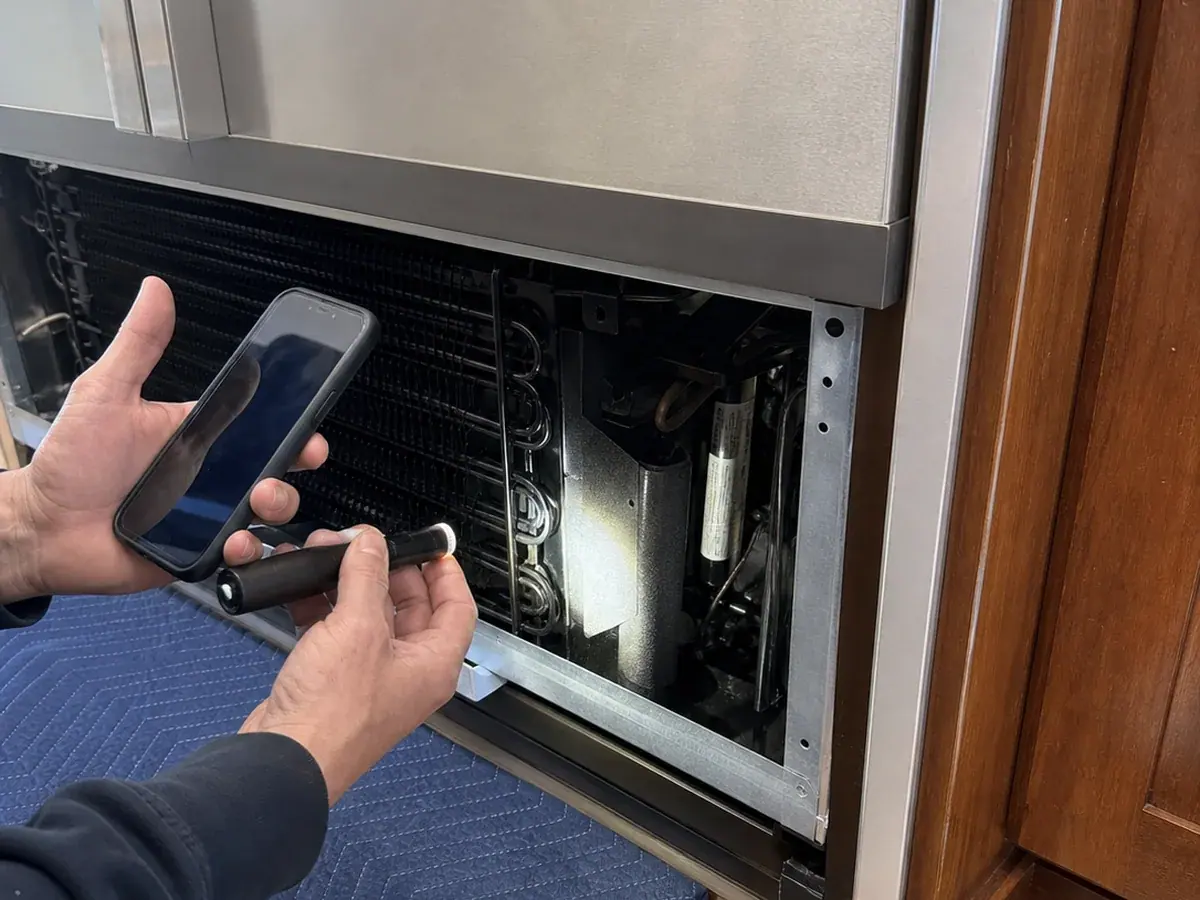
Condenser coil inspection through the grille; condenser fan motor check; ambient clearance measurement. A coil coated with dust or lint can't shed heat, so the wine zone climbs — exactly as a food refrigerator does, but at a narrower margin.
Parts
Condenser cleaning included in the diagnostic visit. Condenser fan motor if amperage draw is out of range.
What changes the quote
Cabinetry that has been built flush to the grille restricts condenser exhaust permanently. We document that finding and advise on cabinet modification if needed.
Wine-column price ranges
Sub-Zero wine column temperature repair costs in Novato
Wine repairs are priced by the evidence: logger trace, zone split, gasket condition, fan behavior and board revision. The display reading alone is not enough to quote the repair.
Wine-column temperature repair price table for Novato
Resistance check, OEM thermistor, zone recalibration
$255-$430
1.5-3 hr
Door gasket compression failure
OEM wine-column gasket, humidity check, seal verification
$320-$590
2-4 hr
Evaporator fan fault
Fan amp/RPM test, OEM fan motor, airflow verification
$345-$625
2-4 hr
Control board or display alarm
Board diagnostics, sensor circuit test, OEM board if confirmed
$495-$820
2-4 hr
Sealed-system suspicion
EPA-certified pressure and frost-pattern verification before quote
$1,650-$3,350+
1-2 visits
The final price is determined by the logged zone trace, not the front display; a 55°F display can hide 59-61°F bottle-level temperatures.
Wine fact
A Sub-Zero wine zone more than 3°F above setpoint for 24 hours warrants service, even if no alarm is showing.
Novato range
Most Novato wine-column repairs involving a thermistor, fan or gasket fall between $255 and $625 after diagnosis.
What to do right now
When to schedule service, when to pause use, and what to send
Schedule service if any of these apply
The cabinet is reading or logging more than 3 °F above setpoint; a display alarm or error code is active and doesn't clear after a power cycle; you can see condensation on the glass or a frost line at the door frame; the compressor sounds like it is running constantly without cycling off. These are not watch-and-wait conditions — temperature drift above 65 °F for red wine or above 55 °F for whites affects what's in the bottles.
Pause use if this applies
If the zone is climbing above 68 °F and you cannot get service within 24–48 hours, move temperature-sensitive bottles to a cool interior location. A wine column running warm in a Novato summer — especially in the warmer inland pockets — can push a light red into damaging territory within a few days. Don't leave it running and hope; the unit won't self-correct.
What to photograph and send before the visit
Model and serial tag. Behind the lower grille, on the upper interior wall, or on the cabinet side — photograph all three lines, including the serial number. That pins the thermistor spec and gasket profile before we arrive.
Current display setpoint vs. a thermometer reading at bottle level. Place a simple kitchen thermometer mid-cabinet for two hours and photograph both the display and the thermometer. That gap — or confirmation there is no gap — is the most useful single piece of data.
Which zone is affected. On a dual-zone unit, note whether the upper zone, lower zone, or both are drifting. A single drifting zone changes the suspect list significantly versus both zones drifting together.
Any recent changes. Cabinet renovation, power outage, moved location, or a firmware update — these are surprisingly often relevant and save diagnostic time.
Model tag photo before parts are matched. The model and serial tag confirms the exact cabinet generation, gasket profile, board revision, and refrigerant specification before a Novato visit.
Local service context
Wine column service across Novato neighborhoods
Temperature drift in a Sub-Zero wine cabinet doesn't present identically across Novato. Install environment, home age, cabinetry style and proximity to the coast all change the most likely fault and how long the repair takes.
StoneTreeLarger custom homes with integrated wine columns framed into hardwood cabinetry. Units here tend to be older 600- and 700-series models where gasket rubber has taken a permanent compression set. Access is usually good, but column-extraction for sealed-system work requires protecting expensive stone surrounds — we pad and plan before pulling.
Bel Marin KeysWaterfront homes with salt air cycling through condenser grilles year-round. Corrosion on condenser fins and fan motor housings appears earlier here than anywhere else in Novato. Wine columns at Bel Marin often present with a condenser restriction that mimics a sealed-system fault — we clean and retest before escalating.
Pointe MarinNewer construction with tight panel-ready installations. Wine columns here are recent-generation Designer or 700-series units with minimal clearance at the sides and rear. Airflow restriction from cabinetry is the most common compounding factor — a marginal evaporator fan that would hold setpoint in an open install fails sooner in a box-fit kitchen.
Marin Country Club (Ignacio Valley)Warmer inland microclimate compared to coastal Novato. Wine columns here are working against higher ambient temperatures in summer, which narrows the margin on a condenser that's even slightly dirty. July heat spells push borderline units over the edge — calls spike in August, and the same unit that coasted through winter needs service by midsummer.
The Rush Creek neighborhood in southern Novato illustrates the complexity well. Homes here are generally mid-1990s to early-2000s builds — a mix of two-story tract homes and townhome clusters. Wine columns installed in that era are older Sub-Zero 400-series and early 600-series units with wiring and control boards that are no longer stocked at most suppliers; OEM sourcing takes longer and that changes the timeline we quote. Cabinetry in these kitchens is typically builder-grade, which actually makes access easier than in a high-end custom kitchen, but the original installation tolerances were often set with refrigerator-style clearance rather than wine-column airflow requirements. Fifteen-plus years of Novato's coastal-inland fog cycles have done their work on gaskets and condenser coils. When a Rush Creek wine column comes in for temperature drift, the diagnostic list is long enough that we plan for a full first visit rather than a quick look.
For homeowners in Historic Old Town / Grant Avenue, Sub-Zero wine storage is sometimes retrofitted into Victorian-era kitchen footprints that weren't built for integrated appliances. In those installs, the cabinet opening itself is often the binding constraint — what the unit can vent and what the gasket can seal against depends on how square the opening was framed, not just on the appliance condition. We measure both before ordering parts.
Evidence-based diagnosis
What we document before touching a part
A wine column temperature drift call should not result in a "probably the board" verdict on the phone. The honest approach is this: we arrive with the control board, thermistor or display alarm on the truck as candidates, not as conclusions. What tells us which one is actually the problem is the evidence we check: temperature readings from a calibrated logger versus the panel display; condenser and evaporator photos showing frost pattern, coil condition, and fan blade state; model-tag proof confirming the exact component revision for this unit; and OEM fan, gasket, and control-board evidence — resistance readings, amperage draw, board diagnostic output — that clear or implicate each suspect before anything is ordered or replaced. That paper trail is what lets us give you an honest quote rather than a hopeful one, and it's what we show you if you ask why one part and not another.
A drifting wine column doesn't correct itself
Temperature drift that isn't diagnosed keeps climbing. The sooner we log the actual zone temperature against the setpoint, the sooner we know whether it's a thermistor, a gasket, a fan, or something that needs more time to investigate. Call with the Sub-Zero model number and a rough sense of how many degrees off the cabinet is running — that's enough to start the conversation.
Answers specific to Sub-Zero wine temperature drift
Why does my Sub-Zero wine column read the right temperature on the display but still feel warm inside?
The front display reads the thermistor nearest the control board, not the wine zone itself. If that thermistor has drifted or the evaporator fan is weak, the cabinet interior can run several degrees warmer than the panel shows. We confirm actual zone temperature with a calibrated logger placed at bottle level — not by trusting the display — before reaching any diagnosis.
What typically causes a Sub-Zero dual-zone wine cabinet to drift off setpoint?
The four most common findings on a drifting wine column are: a thermistor that is reading low and triggering early compressor shut-off; a door gasket that has hardened and no longer seals; a slow or intermittent evaporator fan that can't distribute cold air evenly; or a control board that has lost calibration. The right answer requires logged data and inspection — not a phone guess.
Can Novato's marine climate damage a Sub-Zero wine column faster than in an inland city?
Yes, in two ways. Salt-laden fog cycling through a cabinet's condenser area accelerates corrosion on coil fins and fan motor housings. Humidity also causes gasket rubber to swell and then set unevenly, so a seal that looked fine during a dry summer may develop a leak path by February. Coastal neighborhoods like Bel Marin Keys see this more often than inland Novato streets.
Is an ice maker making hollow cubes related to the same cold-side problem as a drifting wine column?
Not always the same part, but often the same category of failure. Hollow cubes in an ice maker indicate the freeze cycle is cutting short — the cold side isn't pulling temperature fast enough. In a combined refrigerator-wine unit, that can mean a shared condenser load issue, a thermistor fault, or a fan problem that is affecting more than one zone. We check the whole cold side, not just the visible symptom.
What information helps before a wine column service visit?
The three most useful things to send: a photo of the model/serial tag (behind the lower grille, upper interior wall, or cabinet side); the current display setpoint and what a thermometer at bottle level actually reads; and whether both zones are drifting or only one. That combination — model, real temperature reading, and which zone — tells us which parts are worth bringing on the first trip.
How much does Sub-Zero wine column temperature repair cost in Novato?
Diagnosis runs $95–$145 and credits toward the repair. A thermistor or gasket replacement typically falls in the $200–$450 range for parts and labor. A control-board replacement is generally $350–$650. Sealed-system work, which is less common on wine columns, runs $1,500 or more and is confirmed on site with readings before it is ever quoted. All pricing is verified by phone before work begins.
Reviews 4.9 average across our Bay Area Sub-Zero network
What wine-storage customers say
★★★★★
“The display insisted the column was at 55°F, but a thermometer on the upper shelf showed 60°F and my reds were suffering. He put a logger at bottle level, proved a thermistor was drifting, and swapped it. The zone has held 55°F steady ever since.”
Verified customer
Marcus T., Pointe Marin
★★★★★
“Our dual-zone cabinet ran warm up top and the glass was sweating. He didn’t just chase the temperature — he found a tired evaporator fan and a gasket that had taken a set, replaced both, and then verified each zone independently at 55°F and 47°F before leaving.”
Verified customer
Carol B., StoneTree
★★★★★
“Living on the water, the salt air had gone after the condenser fan housing and the wine unit kept creeping to 61°F. He documented the airflow problem with photos, fitted the OEM fan and cleaned the coil, and the compressor finally settled into a normal cycle.”