Skip to content
Novato Sub-Zero repair logo Sub-Zero Cold-Side ServiceAppliance Service Group of Novato · Marin / North Bay (415) 555-0125 (415) 683-1487

Home / Maintenance Calendar

Seasonal service · marine climate

Sub-Zero Maintenance Calendar for Novato — Condenser, Gaskets, Filters by Season

4.9 Google rating47 reviews from Novato & Marin homeowners
Direct answer

In Novato 94947, the most common pattern we find on a Sub-Zero where the fresh-food section is running warm while the freezer still holds is a condenser coil that hasn't been cleaned since the unit was installed. Marine fog deposits fine particulate on those fins year-round, so the condenser loads faster here than in a dry inland climate — and by the time the compressor is struggling on a warm July afternoon, the owner has been slowly losing a degree or two for months. The fix is often a thorough condenser clean, but confirming whether the fan and thermistor are still performing takes a meter, not just a look. Call (415) 683-1487 with your model number so we can plan the visit around the right parts.

A second pattern arrives at the ice maker: slow production, jammed mechanism or hollow cubes that look right but are mostly air. In plain terms the fill valve isn't delivering a full water charge to the mold, either because supply pressure has dropped, mineral scale has narrowed the valve orifice, or the fill cycle itself is cutting short. What confirms it is checking measured fill volume at the valve against the unit's spec, then inspecting the mold surface for scale or cracking. The honest limitation: if the ice-maker control board has faulted independently, addressing the water path alone won't restore production — the board needs to be tested separately before you know which repair actually solves it.

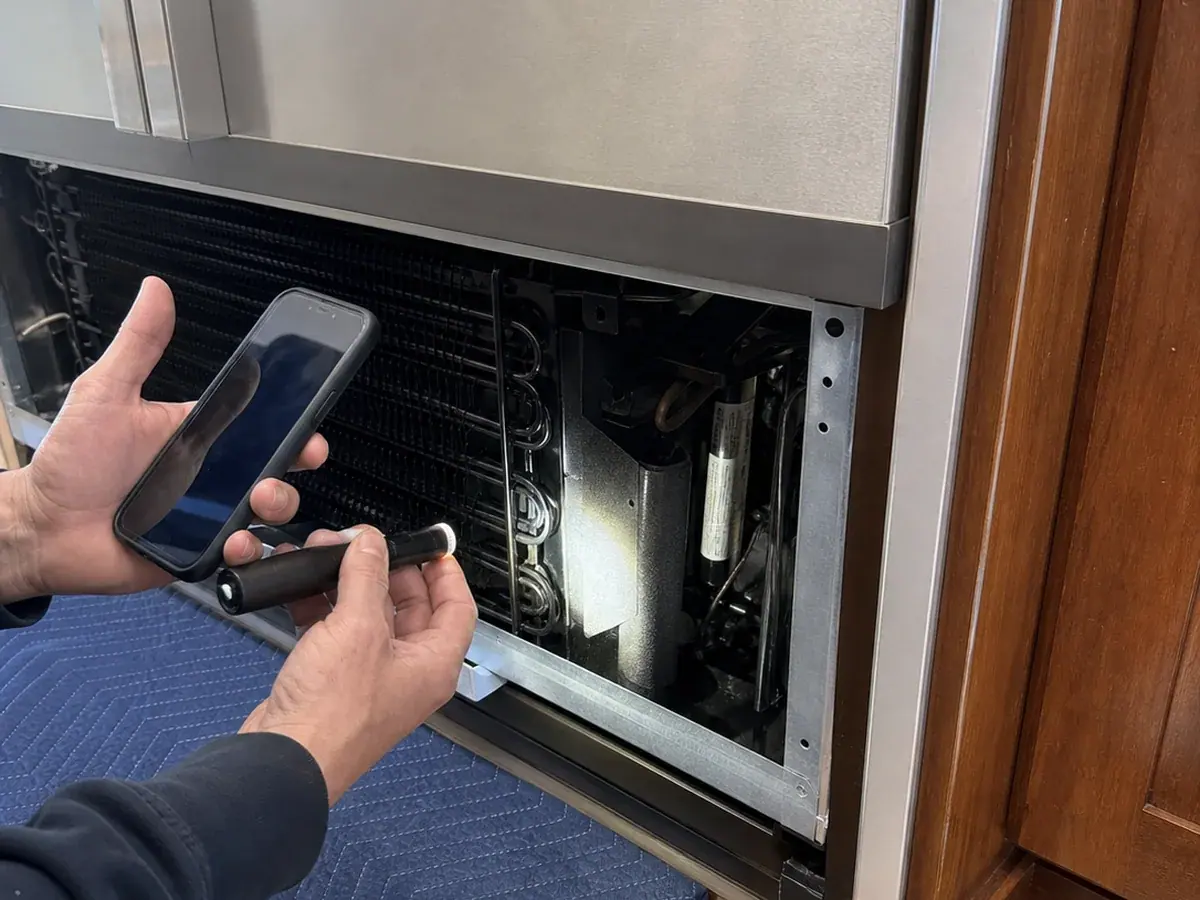
1 · behind grille 2 · interior wall 3 · cabinet side MODEL + SERIAL — PHOTOGRAPH AND SEND
Model-tag locations on Sub-Zero built-ins. The tag lives behind the toe-kick grille (location 1), on the upper interior wall of the fresh-food compartment (location 2), or on the side panel of an undercounter unit (location 3). Photographing it before you call confirms the gasket profile, sealed-system spec and correct OEM part numbers — saving a return trip.
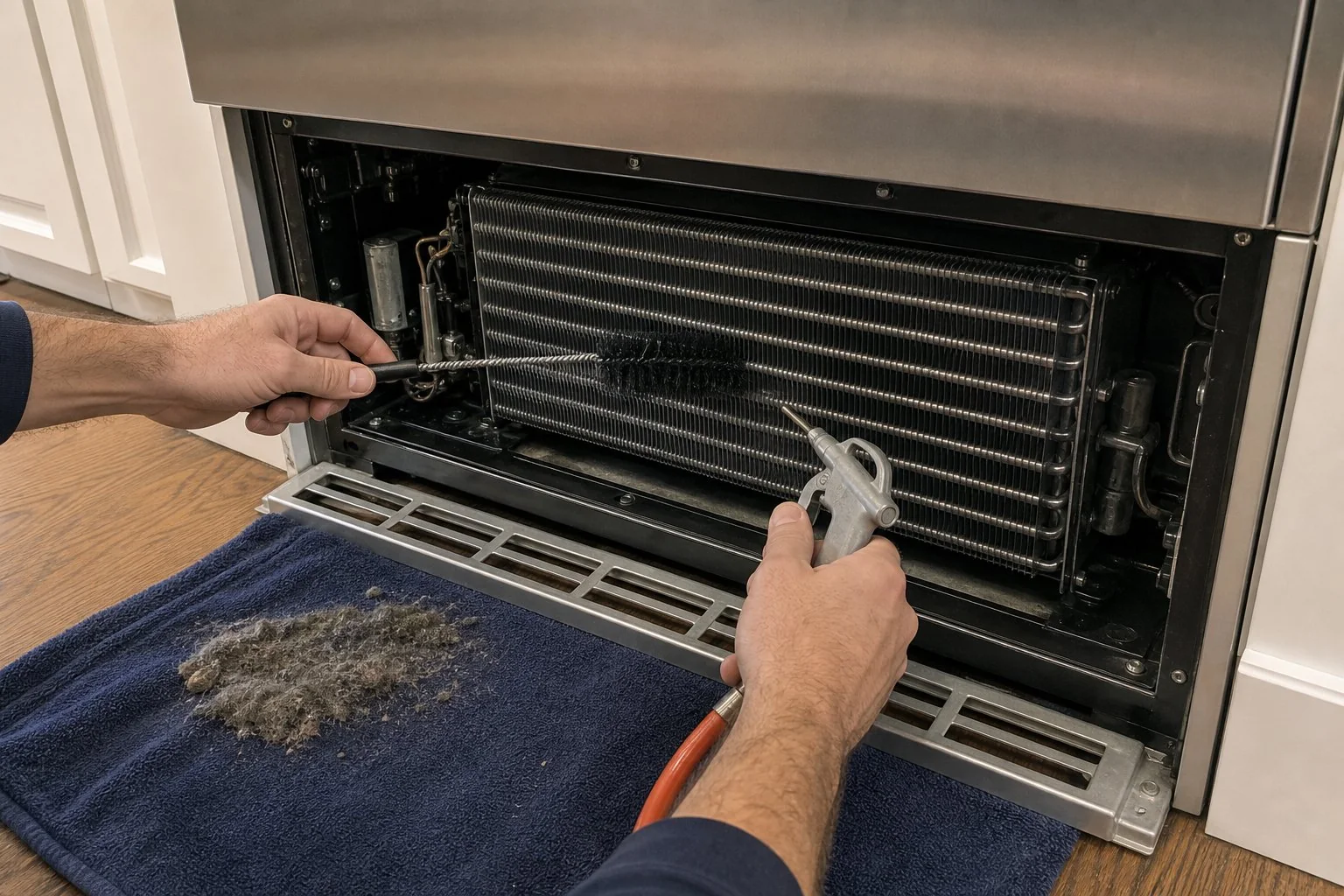
Technician hands brushing dust from a built-in refrigerator condenser during preventive maintenance.
Seasonal condenser care. Novato fog and household dust make coil cleaning a real maintenance item, not cosmetic housekeeping.

Marine-climate timing

Seasonal maintenance calendar — tuned to Novato's fog and salt-air cycles

Novato's climate runs in distinct bands: heavy marine layer and humidity January through April, a brief warm window in May, true inland heat pushing back in June through August, then a second fog season September through November. Each shift stresses Sub-Zero components differently. The calendar below maps those transitions to the task that matters most in each window.

Sub-Zero maintenance tasks by season and Novato climate driver
SeasonMonthsClimate driver in NovatoPriority taskWhy now
Late winter Feb – Mar Peak fog, overnight humidity 80–90% Gasket inspection and door-seal drag test Humidity cycling causes rubber to swell then relax repeatedly; a gasket that passed inspection last fall may have taken a compression set over winter and now leaks warm air at the seal line
Pre-summer Apr – May Transitional — humidity drops, inland warm-up begins Condenser coil cleaning (primary annual clean) Clears a full winter's worth of marine-air particulate before the compressor faces its heaviest load; a dirty coil entering June heat in Novato's inland pockets is the most predictable path to a warm fresh-food section by July
Early summer Jun Inland heat events, low humidity Ice-maker water-line flush and fill-valve check Higher demand for ice surfaces just as scale deposits from a full year of fill cycles narrow the valve orifice; hollow or undersized cubes in June are usually a water-supply issue, not a mechanical failure
Mid-summer Jul – Aug Peak compressor load, overnight cooldown inconsistent Compartment temperature log (fresh-food and freezer) If the fresh-food section is drifting warm while the freezer still holds, summer is when a marginal condenser or fan first becomes a visible problem; logging both compartments for 48 hours gives a baseline before calling
Early fall Sep – Oct Marine layer returns, salt-air concentration increases near Bel Marin Keys Second condenser clean + evaporator-fan acoustic check Salt-laden fog accelerates oxidation on condenser fins; a second light cleaning before the rainy season and a listen for fan-bearing noise catches the two most common causes of winter failures before the rains arrive
Winter Nov – Jan Rain, persistent damp, reduced foot traffic Water-filter replacement (where fitted) and drain-pan inspection Reduced ice usage slows water turnover through the filter; stagnant water in a slow-flushed filter degrades faster; the drain pan under the evaporator accumulates condensate year-round and should be inspected for biological growth before it blocks the drain tube

By component

Six Sub-Zero maintenance tasks — what they involve and when to call

Condenser coil cleaning

Why it matters
The condenser is where the refrigerant cycle sheds heat to the room. When fins are packed with dust, pet hair and the fine organic material Novato's marine air carries, the coil can't transfer heat efficiently. The compressor compensates by running longer and hotter — a slow path to sealed-system stress that shows up first as a warm fresh-food section while the freezer still holds temperature.
What the owner can do
Remove the toe-kick grille, vacuum accessible fins gently with a brush attachment, and check that nothing is blocking the exhaust path at the top. Do not use compressed air aimed into the unit's interior or water near the control board. This gets the surface layer but won't reach matted interior deposits.
When to call
If compartment temperatures don't recover within a few hours after a surface clean, or if the coil is visibly deformed or corroded — which happens on units near the waterfront in Bel Marin Keys — a deeper clean and fan check need to happen before the next heat event. See the not-cooling diagnostic for the full triage sequence.

Door gasket inspection and replacement

Why it matters
A door gasket that no longer compresses flat against the cabinet face lets warm, humid room air enter the compartment continuously. In Novato's marine climate that warm air carries enough moisture to frost the evaporator unevenly and drive humidity inside the fresh-food section above the range where produce stays fresh. The energy cost is secondary to the silent temperature and humidity creep that precedes visible failure.
What the owner can do
Run a slow drag test with a folded sheet of paper along the full perimeter of the closed door. Resistance should be consistent; a spot where the paper slides freely without resistance is a gap. Also look for a compression groove pressed permanently into the gasket — a sign it has taken a set and won't spring back. See the gasket and seal repair page for photos of what a failed seal looks like.
When to call
When the drag test reveals a gap, or when you find condensation forming on the door frame, or a frost line visible inside along the hinge side. Gasket profile is model-specific on Sub-Zero built-ins — ordering the correct part requires the model and serial number from the tag.

Ice-maker water-line flush and fill-valve service

Why it matters
The ice maker depends on a precise volume of water delivered per fill cycle. Novato's municipal water supply carries mineral content that deposits scale inside the fill valve solenoid and on the mold surface over time. Once the orifice narrows enough to reduce flow below the unit's spec, cubes come out hollow, undersized or misshapen — the same symptom that also appears when supply line pressure has dropped at the shutoff valve behind the unit.
What the owner can do
Confirm the supply shutoff behind the unit is fully open. Check that the water line isn't kinked where it runs to the unit. Beyond that, measuring actual fill volume requires accessing the valve and comparing to spec — that's the line between owner-visible and technician territory. The ice maker and water-line page walks through the full diagnostic sequence.
When to call
When cubes are consistently hollow, production has slowed noticeably, or the ice maker has stopped cycling entirely. Also call if the line hasn't been flushed in more than two years and the unit is in a ZIP served by harder water — 94949 around Ignacio sees more scale than the hillside ZIPs.

Evaporator fan and defrost cycle check

Why it matters
The evaporator fan circulates air over the cold evaporator coil and into the compartment. When the fan bearing starts to fail — a process that begins quietly, often as an intermittent hum that comes and goes — airflow drops before the fan stops entirely. In a Sub-Zero with separate fresh-food and freezer evaporators, a failing fan in the fresh-food section causes that section to drift warm while the freezer holds, which is exactly what a dirty condenser also causes. Telling them apart requires temperature logging plus listening at the unit during a cycle.
What the owner can do
Listen for an intermittent grinding or high-pitched hum during compressor cycles. Note whether the sound changes when you briefly open the door versus when it's closed. Log temperatures in both compartments at the same time — if the freezer is fine and the fresh-food section is warm, record the ambient room temperature and time so the technician has context.
When to call
Any sustained or recurring fan noise, or a confirmed pattern where fresh-food temperatures drift up during a cycle while the freezer stays at setpoint. Fan motors are model-specific OEM components; confirming the correct replacement part before the visit prevents a second trip.

Wine column temperature monitoring

Why it matters
A wine column running at a setpoint of 55°F operates at a smaller temperature differential from the room than a refrigerator does. That narrower margin means a partially blocked condenser or a slow gasket leak that a refrigerator might partially compensate for will push a wine column drifting several degrees off setpoint before the compressor log even shows obvious stress. A wine column that reads 59°F on a secondary thermometer when the display says 55°F has already been at that elevated temperature long enough to affect bottles stored near the door.
What the owner can do
Place a calibrated secondary thermometer at mid-rack level and compare its reading to the unit's display over 24 hours. A variance of more than 2°F warrants further investigation. Also check that bottles near the door aren't blocking air circulation — overcrowding the door rack is a common cause of uneven zone temperatures in dual-zone columns.
When to call
When the secondary thermometer consistently reads above the setpoint by 2°F or more, or when the unit is cycling audibly more than usual during cooler evenings. Wine column drifting several degrees is the first thing we document with temperature readings and condenser photos before quoting any repair.

Water filter and drain-pan service

Why it matters
Sub-Zero units with internal water filtration need the filter replaced on a schedule matched to actual usage — not just the calendar reminder on the display. A filter used primarily for ice in a heavily used household exhausts capacity faster than the manufacturer's default interval. A saturated filter doesn't just reduce water quality; it can restrict flow enough to contribute to the hollow-cube pattern described above. The drain pan beneath the evaporator is a secondary concern: it collects condensate continuously and can develop biological growth that eventually blocks the drain tube, causing water to pool inside the compartment.
What the owner can do
Check the filter replacement indicator and replace on schedule. If you've had the unit in service for more than 18 months without a filter change, replace it regardless of the indicator. For the drain pan, there's no owner-accessible check — it requires pulling the evaporator cover, which means calling a technician.
When to call
If you find standing water in the bottom of the fresh-food section, water leaking from the base of the unit, or if ice production has dropped alongside a known overdue filter. These together point to a restricted or blocked drain path that needs to be cleared before the water reaches the compressor compartment.

Owner visibility guide

What you can inspect yourself — and where to stop

Where owner access ends

Do not remove the evaporator cover, the control board panel, or any refrigerant-circuit component. Evaporator frost pattern, compressor temperature, and refrigerant pressure readings are technician diagnostics that require the right instruments and, for any refrigerant handling, EPA certification. Accessing these panels incorrectly can disable the defrost heater circuit or damage the wire harness — turning a maintenance visit into a more expensive repair. Photograph what you can see and call with a description; that is genuinely more useful than a disassembly attempt.

Service context

Where we see this in Novato and the surrounding corridor

The maintenance patterns described above don't affect every Novato home equally. Proximity to the bay and the direction a kitchen faces both change how quickly a Sub-Zero condenser loads. Around Bel Marin Keys, where homes sit at the edge of tidal sloughs off San Pablo Bay, salt-laden fog moves through constantly — condensers on units in those kitchens corrode at the fins faster and need cleaning more frequently than the same unit would in an inland neighborhood. The 94949 ZIP takes the brunt of that marine influence.

Inland from there, StoneTree sits in a warmer, drier pocket that changes the failure pattern: gaskets that hold up at the coast dry out faster here, and the compressor faces more sustained heat load in summer without the fog's cooling effect. Further up the corridor, San Rafael and Petaluma see lower humidity overall but more temperature swing between day and night — which drives the fresh-food section to cycle more aggressively in summer and stresses the thermostat and damper components over time. All of this is background we carry into the visit so the maintenance plan matches the actual climate the unit operates in, not a generic schedule.

Bel Marin Keys / 94949Salt-air corrosion accelerates condenser fin degradation; schedule two cleans per year, inspect fins for oxidation
StoneTree / inland NovatoWarmer summer ambient; gaskets dry out faster; compressor runs hotter July–August — priority condenser clean before June
San Rafael corridorHigher day-night temperature swing; damper and thermistor components see more cycling stress over time
Petaluma service areaLower overall humidity reduces gasket swelling but increases drain-pan dry-out; check drain annually

How we document the work

Evidence before and after — what a maintenance visit produces

A maintenance call that doesn't produce anything you can read afterward isn't worth much. On every visit we document compartment temperature readings before and after the condenser clean, photograph the condenser and evaporator to show the actual state of the coil and frost pattern, and confirm the model-tag details against the parts we're using. When the symptom is a wine column drifting several degrees off setpoint, we include the model-tag proof, a temperature log from the secondary thermometer versus the display, condenser and evaporator photos showing the before-state, and OEM fan, gasket and control-board evidence confirming which components are within spec and which are not.

That paper trail serves two purposes: it tells you what was actually done, and it's what lets us stand behind the result. A shop that can't show you temperature readings and condenser photos before and after has no basis for the number on the invoice — the evidence is how we earn the job on its merits.

Maintenance price ranges

Sub-Zero maintenance visit costs in Novato

Maintenance pricing is lower when the unit is healthy and accessible. It rises when the visit uncovers a failing gasket, fan, valve or sensor that needs an OEM part.

Seasonal Sub-Zero maintenance price table for Novato
Service / symptomWhat is includedPrice rangeTypical timing
Seasonal condenser cleanCoil clean, condenser fan check, before/after temperature note$185-$3251-2 hr
Gasket inspection and bill-drag testDoor perimeter test, humidity/frost check, alignment note$95-$14545-75 min
Water-line flush and ice-maker fill checkFilter review, fill-volume test, valve screen inspection$165-$2851-2 hr
Wine-column logger check24-hour setpoint comparison and condenser inspection$145-$265Setup plus log review
Preventive fan or thermistor replacementOEM part once evidence shows drift or noise$255-$6251.5-4 hr
Deferred maintenance with active warm driftFull diagnostic plus likely repair path$295-$7802-5 hr

The final maintenance cost is set by whether the visit stays preventive or uncovers an active component failure.

Calendar fact
Novato Sub-Zero condensers should be cleaned before June heat and checked again after the September fog return.
Cost fact
A preventive condenser clean at $185-$325 is materially cheaper than a heat-stressed fan or compressor diagnosis later in summer.

Send the symptom and a model-tag photo

A photo of the model and serial tag — behind the grille or on the upper interior wall — combined with a description of the symptom (fresh-food warm, hollow cubes, wine column drifting) is everything we need to plan the visit and bring the correct parts. Call (415) 683-1487 Mon–Sat 7:00am–7:00pm, or book online. Diagnostic fee $95–$145, credited to the repair — confirm by phone.

Related pages: not-cooling diagnostic · door gasket and seal repair · ice maker and water line

Maintenance questions

Sub-Zero maintenance FAQ for Novato owners

How often should a Sub-Zero condenser be cleaned in Novato?

At minimum once a year, but Novato's marine climate pushes that toward twice. The combination of coastal fog, humidity and the fine particulate that drifts in from San Pablo Bay loads condenser fins faster than in drier inland climates. A coil cleaned in late winter before the inland heat arrives and again in early fall covers the two highest-load windows. If you have pets, move to every six months.

What happens to door gaskets in Novato's fog and humidity?

Repeated exposure to humid marine air causes the rubber compound in Sub-Zero gaskets to absorb moisture and swell, then lose elasticity as it dries out again in the afternoon. Over a few seasons the gasket takes a compression set — it no longer springs back flat against the cabinet face, leaving a gap that lets warm room air in. You may notice condensation along the door edge or a frost line inside before the gasket visibly fails.

My Sub-Zero ice maker is producing hollow or misshapen cubes — what causes that?

Hollow or undersized cubes are almost always a water-flow issue: reduced supply pressure, a partially blocked fill valve, or scale buildup inside the ice-maker module restricting the fill cycle. Novato's water supply through 94949 carries enough mineral content to deposit scale in the fill valve and mold cavity over time. What confirms it is checking fill volume at the valve and inspecting the mold surface. The limitation: if the ice-maker control board has also faulted, cleaning the water path alone won't resolve it.

Does a wine column need a different maintenance schedule than a refrigerator?

Yes. Wine columns run at warmer setpoints (typically 55–65°F) than a refrigerator, which means condenser efficiency matters more per degree of drift. A dusty condenser that a refrigerator can partially compensate for will push a wine column several degrees off setpoint before the owner notices. Gasket inspection is equally important — a slow leak at wine-zone temperatures causes gradual humidity and temperature creep rather than the hard frost line you'd see on a colder compartment.

What should I include when I call about a Sub-Zero maintenance visit?

Your model and serial number — both are on the tag behind the grille or on the upper interior wall — and a description of any current symptoms: compartment temperature readings if you have them, whether the unit sounds different (fan noise, compressor cycling), and how long since the condenser was last cleaned. A photo of the model tag sent before the visit lets us confirm part compatibility and bring the correct gasket profile or filter if needed.

Is it worth doing maintenance if the Sub-Zero is already ten or more years old?

Yes, with a caveat. A well-maintained Sub-Zero routinely runs 15–20 years. Preventive condenser cleaning, gasket replacement and water-line flushing cost far less than a sealed-system repair or replacement. The caveat is age compounded by deferred maintenance: if a unit has never had the condenser serviced, the compressor has been running hot for years, and cleaning alone may not recover full performance. In those cases the diagnostic tells you where you stand before you commit to further investment.

Reviews · 4.9 average from Novato & Marin customers

What maintenance customers say

★★★★★

“Their pre-summer maintenance on our 600-series included condenser photos, fan amperage and a temperature log. The $245 cleaning dropped fresh-food recovery from 44°F to 37°F overnight and the unit runs quieter.”

Verified customer
Homeowner, StoneTree

★★★★★

“We booked a condenser clean before the July heat. They used a coil brush, checked the gasket drag and found the ice fill was only 120 mL. A $260 flush and screen clean prevented a hollow-cube call.”

Verified customer
H.K., Ignacio Valley

★★★★★

“The fog season had started a frost line on our fresh-food gasket. During maintenance they caught it early, heat-set the seal and documented the pressure points. The visit stayed under $300 instead of becoming a summer no-cooling emergency.”

Verified customer
Homeowner, Bel Marin Keys
Call (415) 683-1487 Book online