Skip to content
Novato Sub-Zero repair logo Sub-Zero Cold-Side ServiceAppliance Service Group of Novato · Marin / North Bay (415) 555-0125 (415) 683-1487

Home / Error Codes & Alarms

Technical reference · control-side diagnostics

Sub-Zero Error Codes & Alarms in Novato — Safe, Model-Verified Interpretation

4.9 Google rating47 reviews from Novato & Marin homeowners
Direct answer

Sub-Zero built-ins in Novato — including the integrated columns around Ignacio — surface alarms through a control board, thermistor or display alarm that can mean different things on different model families. There is no universal code chart: the same number displayed on a 500-series built-in and a 700-series column may point to entirely different components. Call (415) 683-1487 with the exact display reading and your model number; that combination is what makes interpretation safe.

The second pattern worth understanding plainly: a unit where the fresh-food section is running warm while the freezer still holds temperature. That split — cold below, drifting above — most often traces to an evaporator fan that has stopped circulating air to the fresh-food compartment, a stuck damper, or a defrost fault that has let frost build on the evaporator coil. What confirms it is a calibrated temperature reading in each compartment plus a visual check of the evaporator, not just reading the display code. The honest limitation: if those tests are clean but the alarm persists, the thermistor itself may be returning a false reading — and distinguishing a genuinely warm compartment from a misfiring sensor requires a meter and the resistance spec for your model, not a visual guess.

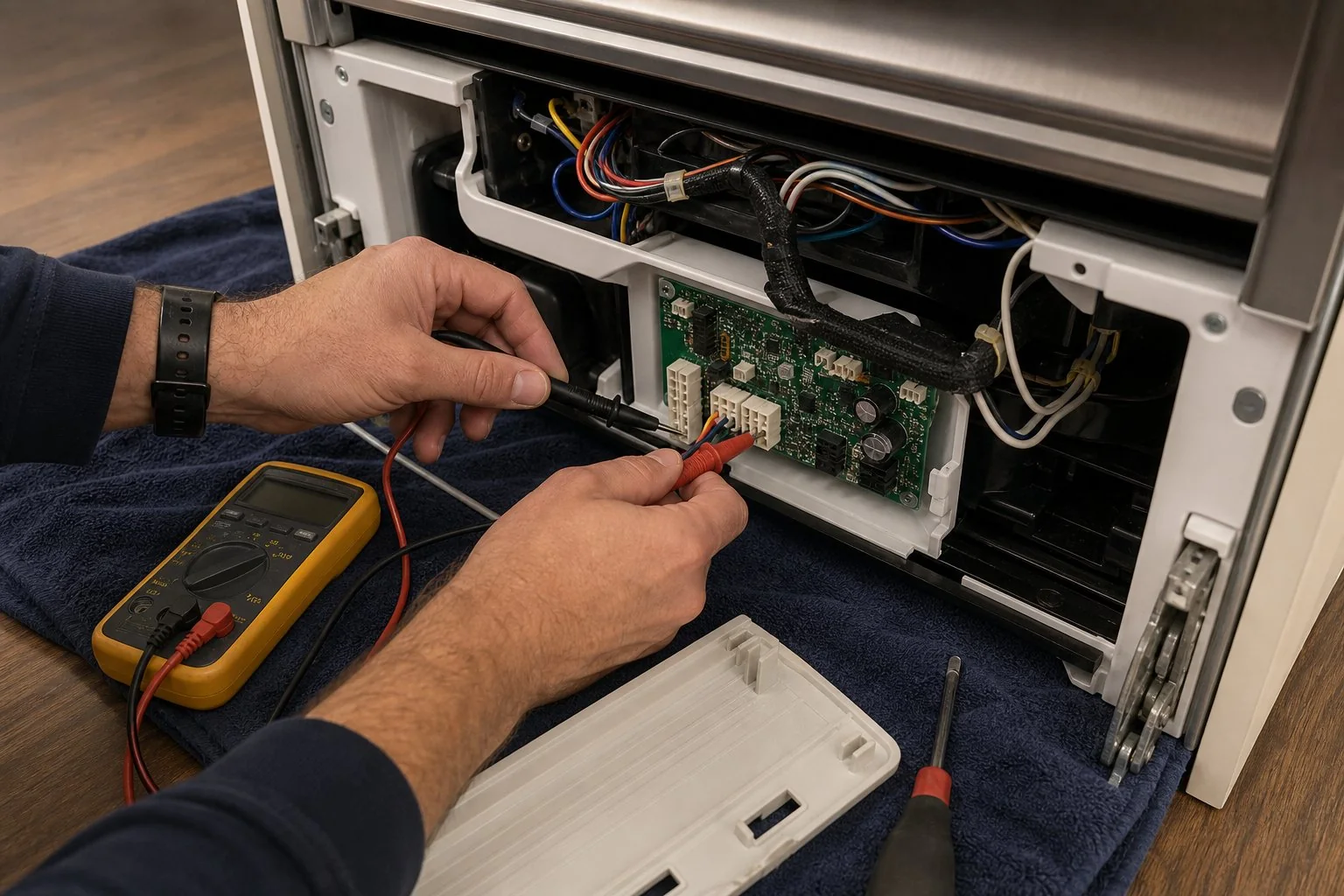
Technician hands using multimeter probes on a refrigerator control board during an alarm-code diagnostic.
Codes still need a meter. Alarm pages narrow the fault family, but board, sensor, and harness readings confirm the repair.

Homeowner safety / technician scope

What a homeowner can safely check — and what requires a technician

Know the boundary before acting on an alarm

Three alarm types look similar on the display but require very different responses. A door-ajar alarm is a mechanical condition — fully closing the door and verifying the gasket seats will clear it; no tools needed. A thermistor or sensor fault shows the same audible alert but persists regardless of door position; confirming it requires measuring sensor resistance against the model-specific specification with a calibrated meter — a homeowner without that spec and tool cannot tell a failed sensor from a normal one. A control board fault can look identical to a sensor alarm on the display but involves live circuit voltages and board logic that must not be probed without proper technique. Attempting to swap a board before confirming the fault is isolated there often destroys a serviceable board and wastes $400–$700. If the alarm does not clear after confirming all doors are fully shut and attempting a controlled power cycle (unplug for two minutes, restore), stop and verify by model and serial before ordering or replacing any part.

Alarm interpretation framework

Symptom-to-component diagnostic table

The descriptions below use generic symptom language rather than invented exact codes, because code assignments vary by model family and must be verified against your unit's documentation. Use this as a triage framework, not a repair prescription.

Sub-Zero alarm symptoms — diagnostic framework (verify by model/serial before acting)
Symptom / alarm Possible component Confirmation test False-positive to avoid Repair path
Audible alarm, display shows a temperature-zone code, fresh-food compartment warm Evaporator fan motor; damper actuator; defrost heater Calibrated thermometer in both compartments; listen for fan spin; check evaporator for frost block Thermistor returning a false high reading when compartment is actually in spec — confirms with meter, not touch Fan or heater replacement if confirmed; defrost forced cycle if frost-blocked; thermistor swap if resistance is out of spec
Continuous tone, all compartments at normal temperature, alarm clears when door is touched Door gasket; door hinge alignment; door not fully latched Dollar-bill drag test along full gasket perimeter; check hinge gap; confirm door latch engages Alarm wiring fault that clears intermittently — does not correlate with door position; requires board inspection Gasket replacement if compression-set or torn; hinge adjustment if door is pulling out of square; see gasket repair page
Display shows a sensor or thermistor fault code, compartment temperature appears normal Fresh-food or freezer thermistor; thermistor wiring harness Measure sensor resistance (ohms) at ambient temperature; compare to model-specific chart — do not use a generic NTC table Genuine temperature deviation masked by a misfiring sensor — thermometer reading in compartment is the ground truth Thermistor replacement with OEM component matched to model; wiring harness inspection if resistance reads open or shorted
Alarm with a communication or board fault indication, unit behavior erratic or unresponsive to panel input Main control board; user interface board; interconnect wiring Controlled power cycle first; if fault returns, test voltages at board connectors and inspect for corrosion or burned traces — requires meter and schematic Power-event latch (brownout or surge) that clears with power cycle and does not return — replace nothing until fault is confirmed persistent Board replacement only after fault is confirmed isolated to that board; address power-quality issues (surge protection) before repair
Freezer compartment alarm, ice maker stops producing, no harvest cycle audible Ice maker module; harvest thermostat; water inlet valve; ice maker thermistor Check harvest thermostat continuity; verify water inlet valve opens on call; inspect mold thermistor resistance; confirm supply line pressure Arm in the off (raised) position — the simplest false alarm; check arm position before any electrical testing Module replacement if harvest thermostat and wiring test normal and cycle still fails; see ice maker & water line page
Alarm after a power outage or brownout, unit otherwise functioning normally Control board fault latch; surge/brownout residual state Unplug unit for two minutes; restore power; observe whether alarm returns and whether temperatures hold Treating a latched code as an active hardware fault — ordering and swapping a board for a brownout artifact is a common costly error If alarm clears and temperatures hold: add surge protection and monitor. If alarm returns: proceed to board and sensor verification by model
High-temperature alarm in condenser zone, unit running continuously, compressor audibly hot Condenser coil (dust-blocked); condenser fan motor; ambient temperature too high around unit Inspect condenser coil for dust loading; test condenser fan RPM and amperage; verify clearance around unit meets installation spec Ambient heat event (kitchen remodel, summer heat spell) that resolves on its own — confirm condenser temperature drops after coil cleaning before assuming fan failure Condenser cleaning; fan motor replacement if coil is clean but fan is slow or stalled; verify installation clearance; see not-cooling diagnostic

Alarm repair ranges

Sub-Zero error-code and alarm repair costs in Novato

Code interpretation starts with the model tag. The same displayed code can mean sensor, board or communication faults depending on platform, so the price range follows the confirmed component, not the code alone.

Sub-Zero alarm and control-side repair price table
Service / symptomWhat is includedPrice rangeTypical timing
Alarm diagnosticModel-tag verification, code capture, temperature readings$95-$14545-90 min
Door-ajar or gasket-triggered alarmDoor switch, gasket drag and hinge check$180-$6501-4 hr
Thermistor or sensor faultResistance check, OEM sensor, temperature verification$235-$4301.5-3 hr
Defrost or fan alarmEvaporator inspection, heater/fan test, OEM part if needed$315-$6202-4 hr
Control board / interface faultBoard output test, harness continuity, OEM board$495-$8202-4 hr
Alarm plus sealed-system evidencePressure/frost-pattern verification under EPA protocol$1,650-$3,350+1-2 visits

The final price depends on the confirmed component; a model-verified thermistor fault is much cheaper than a board swap.

Code fact
A Sub-Zero alarm that clears after a two-minute power cycle and does not return is often a latched power-event code, not a failed board.
Cost fact
Most Novato error-code repairs involving sensors, fans or boards fall between $235 and $820 after diagnosis.

Model-family notes

How alarm behavior differs by Sub-Zero platform

The notes below describe general tendencies we encounter on each platform in Novato. Every observation must be verified against the specific model number and serial prefix before any part is identified — what follows is orientation, not a substitute for model documentation.

500-series built-in side-by-sides

Alarm tendency
Thermistor and defrost-heater faults are the most common alarm source on older 500-series units; the display coding for these faults on this platform does not transfer directly to 600-series units.
Verify by model/serial
Required

600-series built-in / French-door

Alarm tendency
Control board communication alarms appear more frequently on 600-series units with older wiring harnesses; a harness inspection is part of the board-fault protocol on this platform before a board is condemned.
Verify by model/serial
Required

700-series & Designer integrated columns

Alarm tendency
Door-ajar alarms on integrated column units are sometimes caused by panel weight pulling the door slightly out of square over time — a mechanical reseat, not a gasket replacement, is the correct first step on this platform.
Verify by model/serial
Required

UC / UR undercounter drawers

Alarm tendency
Undercounter units have a shorter condenser-to-evaporator path; high-temperature condenser alarms on these units appear at lower ambient temperatures than on full-height built-ins, making clearance verification especially important.
Verify by model/serial
Required

Wine storage cabinets (single- and dual-zone)

Alarm tendency
Zone-temperature alarms on wine units are frequently the first sign of a thermistor drift rather than a refrigerant fault — the wine zone operates at a narrow setpoint where a small sensor error produces a visible alarm before the cooling system is actually failing.
Verify by model/serial
Required

Older BI built-in refrigerator/freezer

Alarm tendency
BI-platform units can surface control board alarms after power events that persist through one power cycle but clear on a second — a behavior not shared with newer platforms; one additional cycle is warranted before condemning the board on this family.
Verify by model/serial
Required

Diagnostic evidence

What a proper alarm diagnosis looks like on paper

Three pieces of physical evidence anchor every alarm interpretation: the model tag that pins the platform, a meter reading at the sensor that confirms or clears the fault, and a visual of the control board that catches corrosion, burned traces or loose connectors before a board is condemned. Larkspur units we service show the same evidence requirement as Novato built-ins — the model tag is the starting point regardless of location.

1 · behind grille 2 · interior wall 3 · cabinet side MODEL + SERIAL — PHOTOGRAPH AND SEND
Model-tag location diagram. The model and serial number determine which alarm code chart applies. Without this, any code interpretation is a guess. Photograph the tag and send it with your symptom description.

Evidence trail

Why evidence documenting matters on an alarm call

An alarm call that results in a part replacement without documented evidence is a gamble on two fronts: you may replace a functional component, and you may miss the underlying fault that triggered the alarm. The evidence trail we build on every visit in Novato — temperature readings across both compartments, condenser and evaporator photos showing the actual thermal state, model-tag proof that confirms which platform and code set applies, and OEM fan, gasket and control-board resistance checks that clear the cheaper suspects — is what turns an alarm code into a repair decision rather than a parts lottery.

That same evidence discipline applies when the complaint is an ice maker slow, jammed or producing hollow cubes alongside an alarm. A hollow-cube complaint paired with a harvest-cycle fault code narrows to the harvest thermostat and water fill volume; the evidence is the thermostat continuity reading and the actual cube weight, not the alarm alone. Customers in San Anselmo who have brought us a unit that a previous technician "fixed" by swapping a board or module blind know exactly what undocumented alarm interpretation costs — a second repair bill for the component that was actually failing. The model-tag photo you send before the visit is the first piece of that evidence chain.

Send the symptom and a model-tag photo

Describe what the display shows, how the alarm sounds, and which compartment (if any) is out of temperature. A photo of the model/serial tag — behind the grille, upper interior wall, or cabinet side — lets us identify the correct code set before the visit. Diagnostic fee $95–$145, credited to the repair. Mon–Sat 7:00am–7:00pm.

Error code questions

Frequently asked questions — Sub-Zero alarms

Can I look up my Sub-Zero error code on a generic online chart?

Generic charts are risky because Sub-Zero assigns different meanings to similar display codes across model families. A number that flags a thermistor on one platform may indicate communication on another. Use the chart only after confirming your model and serial tag; we verify both before recommending any part.

My display shows an alarm but the unit still feels cold - should I be worried?

Do not panic, but do not ignore it. Some alarms appear before temperature drift, such as a door held ajar, a thermistor slightly out of range or a late defrost cycle. Write down the exact display, check the doors, and call with the model tag so we can decide whether it is routine or urgent.

What is the difference between a door-ajar alarm and a true sensor fault?

A door-ajar alarm clears when the door closes and the gasket seats. A thermistor or sensor fault persists through door cycling and is confirmed by measuring resistance against the model-specific spec. They can sound identical on the panel, so the distinction comes from door behavior, compartment temperature and a meter reading.

Fresh-food is warm but the freezer holds - is that an error code issue?

Sometimes, but the physical symptom matters more than the code. Fresh-food warm with freezer near 0°F usually points to evaporator fan, damper or defrost problems. Those faults can trigger a thermistor alarm, but confirming them requires actual compartment readings and an evaporator inspection, not display interpretation alone.

How much does it cost to diagnose a Sub-Zero error code in Novato?

The diagnostic fee is $95-$145 and credits toward approved repair. Sensor and thermistor repairs usually run $235-$430, fan or defrost repairs $315-$620, and board repairs $495-$820. Sealed-system work is much higher and starts around $1,650, but it is only considered after simpler faults test clean.

Can a power surge or brownout trigger a control-board alarm?

Yes. A brownout, brief outage or voltage spike can latch a fault on some Sub-Zero boards. A controlled two-minute power cycle can clear a non-active latch. If the alarm returns, appears with temperature drift or repeats after a reset, treat it as a real fault that needs meter verification.

Reviews · 4.9 average from Novato & Marin customers

What customers say about code diagnosis

★★★★★

“Our 700-series displayed a recurring sensor alarm but still felt cold. They matched the code to the model tag, metered the thermistor, replaced the OEM sensor for $345, and the alarm stayed clear for 72 hours.”

Verified customer
Homeowner, Pointe Marin

★★★★★

“A brownout left the panel flashing in our Hamilton kitchen. They proved the board output was normal, found a door switch sticking after panel alignment, adjusted it for $220, and saved us from a $700 board replacement.”

Verified customer
R.J., Hamilton

★★★★★

“The code pointed one way online, but the model-specific chart said otherwise. They tested the fan circuit, replaced a weak evaporator fan for $510, and fresh-food temperature recovered from 46°F to 38°F.”

Verified customer
Homeowner, Novato 94949
Call (415) 683-1487 Book online